Showing posts with label conservation. Show all posts

Saturday, 23 June 2018

Adventures with Blue Whales and Blue Waters

My book review - Adventures with Blue Whales and Blue Waters - featuring The Secret Life of Whales by marine biologist, Micheline Jenner; and The Oceans, A Deep History by paleoceanographer, Eelco Rohling - was published by Cosmos Magazine Winter 79 Edition.


I recommend both books, which are very different stories, but written by scientists who share a great respect and love of the ocean and its wildlife. Fantastic stories.


Eye for Adventure

The ocean is there to be discovered and Steve Brady is an intrepid diver who has explored many underwater locations with a salty tale to tell.

“We’ve got it all and there’s just so much diversity of marine life in and around Australia. It’s amazing” Brady says. “This is probably a funny thing to say but if I had gills I’d be a very happy boy.”


With a litany of dive experiences under his belt, Brady wanted others to learn what the ocean has to offer. Informed by research from marine biologists and feedback from pro divers, he developed a calendar featuring marine wildlife events throughout the year, and uses the calendar to schedule dive trips at all levels of experience from beginner to advanced around Australia and beyond.

“Finding where you can go to see certain marine life is a very big thing for people and I’m the same. I want to see mola molas, I want to see mantas, so I want to go to a place that has the best chance at the best time to see them” says Brady.


Brady has an eye for adventure and despite the unpredictable nature of the sea, he is not deterred from making new discoveries. He recalls an incredible rendezvous with a manta ray after travelling out to an open ocean destination via spotter plane in West Australia.

“In West Australia we went to the township of Coral Bay. We specifically went out on a trip where they have spotter planes, and you aren’t on a reef. You’re in open water. Sandy bottoms, maybe twenty metres of water and you’re snorkeling with them. They’re just down there, just swimming around, very acrobatic, very inquisitive. Just to have one of them come gliding over the top of you, that’s very special” says Brady.


Australian dive sites are world renowned for their pristine waters, thanks to clean up projects led by conservation organisations and social media groups. Despite awareness campaigns and changes to the community’s attitude toward disposing rubbish, microplastics are severely impacting the health of marine life globally.

When marine organisms filter seawater for their food and to absorb oxygen, they vicariously take in these tiny microplastic pieces. This plastic can become lodged in digestive and respiratory tracts, causing animals to suffer health problems or worse, mortality. In the ocean, it's not just small filter feeding species like corals and clams that are being negatively affected, the larger pelagic animals, whales and sharks, are also being hit hard by this invisible threat. 

“Plastic is everywhere, even in places we can’t see” says Ian Kiernan, founder of Clean Up Australia, an organisation that coordinates community clean up events of the environment every year in Australia and worldwide.


“Even if you aren’t really concerned about the health of marine creatures, you might pause when you know that you cannot escape that easily because they are in our drinking water” Kiernan says.

To decrease the problem of microplastics in our water, Kiernan recommends consumers buy clothes made with natural fabrics instead of synthetic material and avoid purchasing products like cosmetics, soaps, shampoos and detergents that do not clearly state they are free of microplastics.


Another way of overcoming obstacles to the continued health of the marine world is through ecotourism, which is offering coastal communities the benefit of financial return, by showing visitors how beautiful preserved natural environments are.

The Great Barrier Reef along Queensland’s coast and Ningaloo Reef off Exmouth in West Australia, both World Heritage listed areas, are prime examples of ecotourism’s success.


Divers share their once in a lifetime experiences when they dive with whales, sharks and dolphins through social media, attracting a lot of attention which ultimately turns marine species into major tourism draw cards overnight. “People’s expectations are all different and everyone enjoys diving around the coral. But when people are fortunate enough to see species like mantas that would be their trip for the rest of their lives” says Brady.

Spectacular Coral Sea locations lying beyond the Great Barrier Reef are a prize ready for the taking. “You’re talking thousands of metres of water, massive drop offs, just awesome visibility and you will get large pelagic marine life out there. If you like sharks, that’s the place to go” says Brady.

Another exciting dive destination is the S.S. Yongala shipwreck, which sunk in 1911 off Alva Beach, Ayr, in North Queensland. “It’s a feeding station for mantas, bull rays, groupers and sharks. It’s safe to go learning to dive because you don’t have strong currents. You’ve got pristine visibility. You’ve got nice corals. I would promote it as one of the best places to learn to dive” says Brady.


The Ribbon Reefs are part of the Great Barrier Reef, which extend from Port Douglas all the way up passed Lizard Island. 

“In June, July each year, you get the migration of the Minke whale coming through and that’s very special. That’s really a highlight for me in terms of marine species” says Brady.

And for the nouveau diver who stumbles upon a manta ray or a whale shark for the first time? 

“You just let them be in their natural environment, you let them be the inquisitive one and you’re in for a great experience” says Brady.

Report by Gabrielle Ahern

Steve Brady manages ‘Dive In Australia’ located in Cairns (https://diveinaustralia.com.au) a travel agency matching dive companies to divers looking for their ideal wildlife encounter.

All images © Steve Brady - Dive In Australia - www.diveinaustralia.com.au

My interview with Steve Brady will feature in a future podcast episode of the Noisemaker series. So stay tuned.


Sunday, 13 May 2018

Episode 1 - Noisemakers Series by SaltyWaveBlue

The new Salty Wave Blue podcast series – Noisemakers – presented by Gabrielle Ahern, features interviews with scientists talking about their research discoveries, new innovative technologies advancing science investigations, amazing sounds from the noisemakers of nature, different quizzes to solve and some fascinating tales to follow from the #rainforest to the #reef. 

Stock Media provided by Pond5.

Wednesday, 27 September 2017

Kissing coral in the Great Barrier Reef


Tube lip wrasses use mucus-coated lips to feed on the surface of corals. When they feed, these fishes close their mouths, push their fleshy lips against the coral, and suck off the coral’s mucus and flesh. These “kisses” are possible thanks to a protective coat of slime around their lips. Image courtesy of Victor Huertas and David Bellwood.

Small changes in any organism take millions of years and multiple generations to evolve and learning why the design and function of certain traits are successful is not as easy. Tube lip wrasses are a familiar sight in tropical coral reefs across the Indian and Pacific Oceans and recognised for their thick, fleshy, tube shaped lips. 

Intrigued by this conspicuous physical adaptation, fish biologists Victor Huertas and Professor David Bellwood from James Cook University decided to investigate further. “We wanted to see if this morphology in the lips of tube lip wrasses matched with the hypothesis they feed on coral mucus” Huertas says.

Damaged coral produces more mucus than healthy coral and observations in the field report tube lip wrasses preference for feeding in damaged coral areas. Coral mucus is not a nutritional source of food for fish and it is difficult to imagine how these wrasse species survive on it.

To the naked eye, the lips of Labropsis australis appear smooth but when magnified by scanning electron microscopy the images revealed the surface has numerous grooves similar to the underside of a mushroom with a reduced tooth. It is a remarkably different trait when contrasted to the lips of other reef fish and even those of typical non-coral feeding wrasse species, Coris gaimard, which have thin, smooth lips with a protruding tooth. “There are species of damsel fish that have larger than usual lips. But it was only in these tube lip wrasses, these fish that feed on coral, that we observed this new adaptation” says Huertas.

The mouth of a tube lip wrasse with self-lubricating lips. 
These lips enable the fish to ‘kiss’ mucus and flesh from the surface of corals. 
SEM image courtesy of Victor Huertas and David Bellwood.

It is normal for any fish to produce mucus from their skin, they’re slippery to hold onto when you catch one. So it was extraordinary when histology showed the mouth of L. australis contained a very high proportion of mucus-secreting goblet cells. “We noticed that among these groups there was a large number of mucus producing cells. Occasionally, you find goblet cells in the lips and the lip skin but it is quite rare. In this case, what we saw is a lot of them” says Huertas. “This was the eureka moment. We realised this is what enables the fishes to feed on coral”. 

In their paper “Mucus-secreting lips offer protection to suction-feeding corallivorous fishes” published in Current Biology early in 2017, the authors compared the grooved lips to tissues that usually line a fish’s gut. “The reason why we wanted to make the analogy is to highlight surfaces or tissues that specialise in either secreting or absorbing substances, generally tend to show this type of morphology” says Huertas.

How all these elements conspire together so successfully shows the devil in the design. High-speed videos recorded L. australis swim toward a coral with its closed mouth forming a tube to suck off coral mucus and flesh. The ‘kissing action’ or suction only lasts a brief 13.1 milliseconds and you can actually hear a short ‘tuk’ sound.

Tube lip wrasses use mucus-coated lips to feed on the surface of corals. When they feed, these fishes close their mouths, push their fleshy lips against the coral, and suck off the coral’s mucus and flesh. These “kisses” are possible thanks to a protective coat of slime around their lips. Gif image courtesy of Victor Huertas and David Bellwood.

It appears as though the fish suck up the coral mucus through their lips like a straw. The fish don’t appear to grab or hold any coral material and the lubricated lips enable the fish to latch onto the uneven surface and achieve a more efficient suction. “The problem with tube lip wrasses is they have to push their lips against the coral surface, so these lips become exposed all of a sudden to the coral they fancy” says Huertas.

Huertas suggests the slime produced from their lips is a protective mechanism, which shields the fish from stinging nematocyst cells that might be accidentally eaten; and from any damage posed by the sharp coral surfaces. “If they didn’t have this mucus they would probably not be able to feed on corals” says Huertas.

Traditionally, it has been assumed tube lip wrasses fed on coral polyps like butterfly fish. “They do not inspect the coral surface very carefully. They pretty much go in there and start striking. If they were feeding on specific things that grow on the coral surface, like parasitic worms, you would expect to see the fish approach and then stop and inspect the surface, but that’s not what we saw” says Huertas.   

18 species out of the 600 wrasses in Family Labridae feed on coral in the Great Barrier Reef and judging by the population numbers of wrasses distributed across reefs in the Indo-Pacific region, the success of these slimy sucking lips is evident. Determining what triggered this unusual feeding trait is the pandora box the researchers are looking forward to opening.

“Tube lip wrasses have found a very creative way to overcome the corals defenses. How this mechanism happened in evolution? We really don’t know. But we know that these are the only group of fishes that have been able to evolve it. There could be others, but so far, this is the only one that we have found” Huertas says.

Story by Gabrielle Ahern
My interview with Victor Huertas will soon feature in the SaltyWaveBlue podcast series so stay tuned!

Monday, 23 January 2017

Coral reef fish – Butterflies of the oceans

Butterfly fish (Family Chaetodontidae) are one of the most conspicuous of the fish species inhabiting coral reefs worldwide, due to their beautiful colour, distinctive markings, morphology and interesting social behaviour. Butterfly fish species remain close to coral reefs all their lives as research shows these fish depend on coral species and other reef organisms for food, habitat and protection from predators. Generalist feeders (that rely on a variety of food sources in addition to coral species) are less common than butterfly fish that consume only corals and experience slower growth rates than their corallivorous counterparts.


Butterfly fish swimming in its coral reef habitat. Photo © Anje Ranneberg

Interestingly, some butterfly fish species have a preference for a particular species of coral so their habitats location might be linked to the type and amount of coral substrate present at various locations along the reef. The reefs exposure to the currents and the protection it provides against egg predators might also be reason’s influencing fish preference for a location over other sites. Studies have revealed some butterfly fish species have a home range they explore to forage for food.

As juveniles, butterfly fish have been observed to find a monogamous mate. This type of pairing early in development decreases the stress levels experienced by these fish, for example, they expend less energy defending their home range or competing with other butterfly fish to reproduce. The constraints that solitary fish or fish living in a harem experience, may play to their favour. Female territories have been observed close to the male, which allows the male to protect and maintain his territory, resulting in less energy being used, much like the monogamous pairs but with multiple chances for fertilising opportunities.

Coral reef habitat. Photo © Vincenzo Piazza 

Butterfly fish use complex forms of social and mating behaviour to exploit the ecological advantages available on the coral reef. Their courtship patterns are an interesting window to their survival. Some butterfly fish mate before sunset. This timing reflects their natural behavior but also increases the chances of egg survival from predation by other fish. Some rogue male butterfly fish are opportunistic and intrude on a spawning monogamous pair by attempting to fertilise the female’s eggs with their own gametes.

Once the eggs of butterfly fish hatch, larvae usually settle close to their native spawning grounds, but this can be a temporary strategy to avoid predators or to find food quickly while migrating to another site. Many view habitat destruction from storms and cyclones negatively, but in the marine environment they have a positive affect, because the amount of coral reef refuge for butterfly fish larvae to settle in increases.

Colour might also be a reason for the success of butterfly fish in coral reef environments. Butterfly fish species are well known for their beautiful markings, which might protect individuals from attack by their counterparts or assist mate recognition. Other cues butterfly fish use to identify their mates from other fish are the sounds they make, for example, some make grunting noises while others slap their tails. So a combination of colour and sound cues improves the success of mating, territorial protection and defence against predators. 

Butterfly fish are linked to coral reefs through their colour, morphology, social behavior, courtship, mating patterns and the sounds they make. Their dependence on coral species for food, protection and recruitment, highlights their potential as a coral reef health indicator species. Coral species are experiencing declines from the effects of warmer oceans, smothering from sediment, disturbance from infrastructure development and fishing pressures.

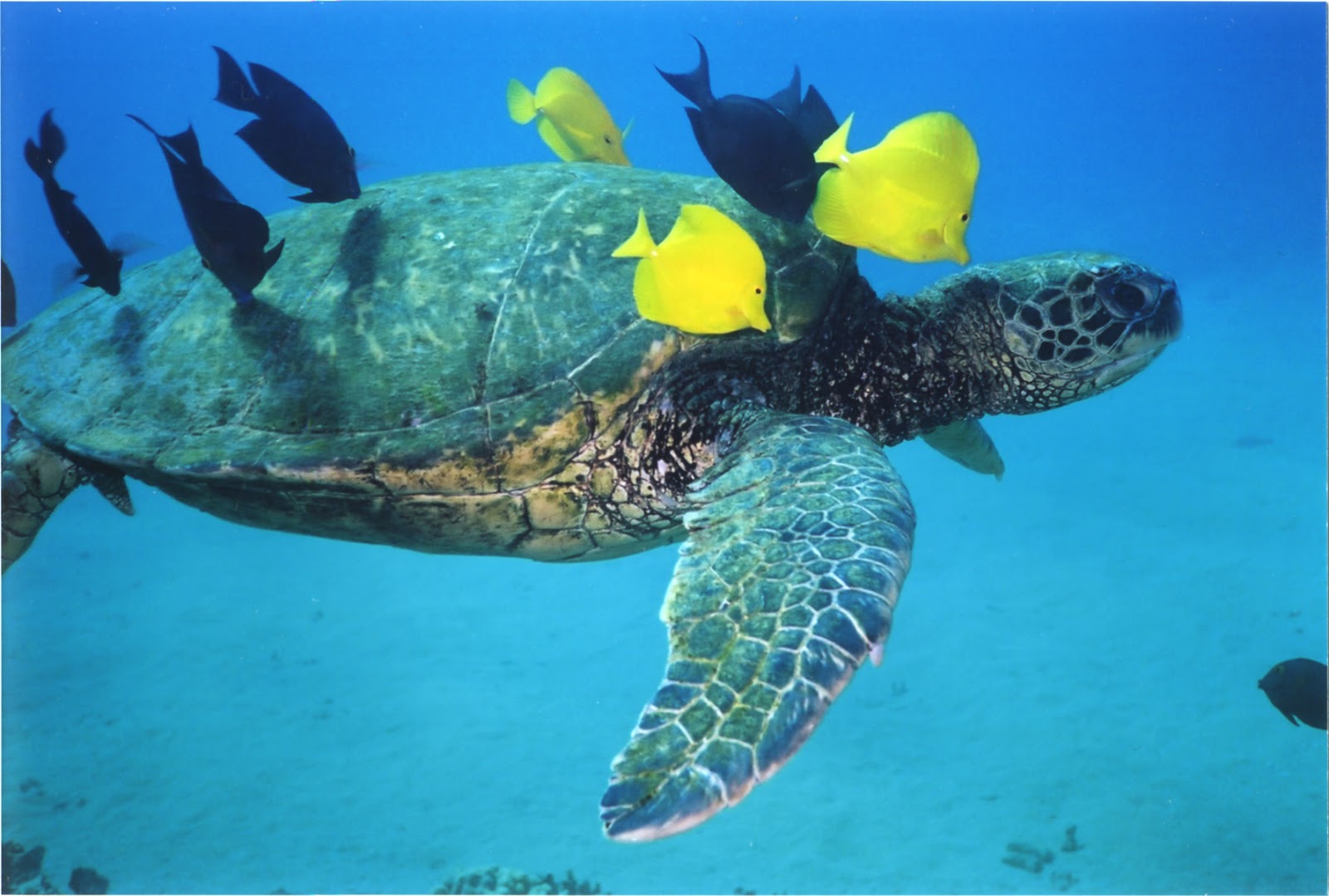
Green sea turtle swimming off the Hawaii Islands. Photo © Chris LaCroix

A combination of all these factors and pressures from the natural environment are creating extreme conditions coral species cannot withstand for long periods of time. Although present studies are working to identify tolerant species of coral that cope with more hostile environments, alternative methods can also be pursued, by protecting coral reefs through expanding marine parks and reducing the activities that are causing their decline both in the marine and terrestrial environments.

Research studies provide evidence of how coral reefs, other marine habitats and associated plants and animals are being affected. These studies have not just been completed in the last few years but over centuries. Considering the weight of evidence that is available to read; and the benefit provided by the natural environment, you have to wonder why the facts presented by scientific research to reduce negative activities are continually being ignored.

Butterfly fish are more than just a fish species swimming around coral reefs, they have developed different ways to communicate with one another, using colour, movement and sound, creating an unforgettable panorama of beauty on many levels.

Written by Gabrielle Ahern

Salty Wave Blue – Into all things ecology.


Follow @SaltyWaveBlue on @Instagram and @Twitter

If you would like to see images of  animals in their environment, especially butterfly fishes and coral species,  please take a look at my Pinterest site: 


Friday, 5 August 2016

WARM FOREST WALK

Forests survive in many types of environments all over the world, so it is no surprise that these same trees can thrive at the National Arboretum, Canberra, Australia. Someone recommended the National Arboretum as one of the more interesting places to see while I am here; so I thought I would take a look, as I love trees and was really curious. The National Arboretum was not what I expected.

Looking up to the tree tops at the Aboretum. Photo © Gabrielle Ahern

It was opened in February 2013, following much discussion about how the site would be managed. A devastating bushfire all but destroyed the area in 2001 and 2003. The Arboretum is the realisation of a design originally created by Walter and Marion Griffin in the early 1900’s. Many voices were productive in the development of this area, with the result being an incredible conglomeration of forests from various global locations. I was fortunate to arrive when a walking tour was leaving. The Guide was like a Pandora box of information. There are apparently 94 forests of rare, endangered and symbolic trees. The trees are in ‘forest’ terms only new and the Guide described how this place would look in one hundred to two hundred years. I can only but imagine the difference time will make to this site.

Walking through a forest of trees. Photo © Gabrielle Ahern

Naturally, it was one of the coldest days to visit with winter temperatures close to zero as we visited ‘warm trees’ wrapped with knitted scarves. The scarves were knitted by many people interested in attracting visitors to explore the Arboretum during the time of the year when trees are naked of leaves. The trees trunks are clothed in colorful displays and provide a stunning contrast to the bleak winter landscape.Trees, of course, grow into all sorts of shapes and sizes and smaller statured trees should not be ignored. The National Bonsai and Penjing Collection of Australia houses nearly 80 native and exotic trees all year round. It was an incredible walk through a forest of trees that are normally colossal but in miniature. 

The Arboretum. Photo © Gabrielle Ahern


Ironically, it houses the oldest tree at the Arboretum, which is over 130 years old. If you are interested in learning the art of bonsai, there are workshops and training courses available. The Arboretum is the place for studies into forest ecology, with the Australian National University managing research about the impact of climate change and trees reaction to changes in temperature and rainfall.The many trails are a fantastic diversion for walkers or cyclists to travel through the forests. The Village Centre caters for visitors with a café and restaurant, and if you would like a souvenir there is a gift shop. I bought some seeds.

Wattle tree in bloom. Photo © Gabrielle Ahern

A feature of the National Arboretum and a way to appreciate its growing forests and the Australian Alps is the view from Dairy Farmers Hill. You’ll notice a small forest of Aleppo Pine (Pinus halepensis). These trees were cultivated from seedlings of the commemorative Lone Pine planted at the Australian War Memorial in 1934 (a gift from the Turkish Embassy). Something hard to miss is the incredible iron sculpture of an eagle on its nest.

Photo © Gabrielle Ahern

I recommend the National Arboretum to anyone who loves trees and supports their conservation worldwide. Whatever your personal interests you walk away with a great sense of the forest.

Written by Gabrielle Ahern

Salty Wave Blue – Into all things ecology.

Follow @SaltyWaveBlue on @Instagram and @Twitter

If you would like to see images of forests, especially trees, plants & flowers, please take a look at my Pinterest site: https://www.pinterest.com/saltywave

Reference
Aboretum – The magazine for the National Aboretum Canberra Issue 2, Spring 2013 

Website Link

Fun Fact
Did you know the leaves of the monkey puzzle tree (Araucaria auracana) may remain on the tree for thirty years.